20100913

Eco in Denmark: Djursland means Animal Kingdom :)

Friland, the ecovillage where I am staying, is in a province called Djursland. "Djur" in english means "Animal". And land is land, so this truly is dedicated to the earthy beings. Then what to do? Of course, I'd go to the local zoo for a daytrip! Even though many animals keep "prisoned" in zoos, I find this one, called Ree Park, more "ecological", as some of the species there are endangered and only if kept in a zoo, they can survive human changes and environmental changes, as we have not payed enough attention to them before. But apart from this, sure I'd like to see them better in their own environment! The savannah is way too small for them here.

Photo album from Kyse is up

Photo album from Copenhagen is up

20100911

I'm making a smaller installation for SupportPakistan

At the moment I got a happy task from Caroline at Engineers Without Borders, which makes me feel I can contribute on a minor scale for a major project. It is to make a small installation in the same dimensions as the bigger houses, to be shown in TV and on stands. And if I had the money, I'd travel down to Pakistan immediately and help them out! They are planning to set up some hundred thousands of this straw bale house below, to shelter people in the cold mountains during the winter. This installation by the way, is making its way to danish tv-stations very soon to be presented, and it is to show the people donating money where their money goes. I think many people like this project, because it is so specific and practical. I am happy that they are getting more publicity to collect more money for this important project of theirs.

20100907

Eco in Denmark: The green sculpture at Aarhus Festival !

On September 4th, I went on daytrip to The Aarhus Festival, an annual celebration of the city and its growth and expansion in primarily cultural and social directions. Aarhus in Denmark is a city known for its cultural design, in which for instance norwegian city Drammen (one of my hometowns, and which has become very famous for its expansion in "city wellness" and moving from industrial city into cultural city) has its inspiration from on cultural developement and city infrastructure strategies (at least from what I learned at Cultural Admin- studies in Telemark University College in '08).

Aarhus has now become, very similar to Drammen, enormously proud of their social togetherness. Culture, we must not forget, is very connected to environment and, individual. Cultural design, is based on knowing that there is "culture" everywhere when there is more than one person in the same environment making a task. So, you might say, pride is also a result of togetherness-structure, and not necessarily a human individual feeling. Even though, no one can take away your feel of liberty when walking down a clean car-free street and with your hands full of money, shoppingbags or an ice cream. But, the point is that the ice cream, and the shoppingbag, and your money, is not in your pocket at all - they're designed to be in the area of the cultural infrastructural design that somebody created as a city.

A storytelling tent, an art installation with light design inside

What this has to do with ecology? Quite alot. City developement tells alot about ecology, in fact it is just flagship by flagship structuring our feeling of not only togetherness, but mostly freedom and simple living. The feeling of being completely free of duties and mess, and with planted trees among roundabouts and little plastic lakes popping up here and there. It is simply designed after your heartbeat. And, very much in the time of this time. The green times.

Aarhus has got it at least in the sentence of knowing, except from being just another town. And here is their proud sculpture:
The text zoomed-in on the green sculpture of Aarhus
The text on this sculpture says: "The Green Pavillion" - With this unique sculpture, Skykon A/S wishes to signify Aarhus' green image. The Green Pavillion is developed in a sensational material of bio degradability consisting of soya beans, cork, flax and corn in material, which will contribute on a major scale in developing new equipment for composite production in the wind mill industry. A pleasure for all of us. You might touch this sculpture!"

The green thing was standing on a grass field in the section called ParallellUniverse Festival, a music concert area of free entrance sa part of the Aarhus Festival, supporting fair football as well as upcoming artists. I could listen to some very nice electronica by Dj Foxfire, a very good one I must say! The danish are some hiphopper-gangsta-lovers.:) The fair football included people passing by to join. There was also a FairTrade-shop for coffee and drinks with volunteers working. A nice section, too.
Reading corner, free seats and concert scene

Eco in Denmark: Brushing some lime plaster on walls

In the first few days here at Friland, I started as mentioned with whitewashing (or not clearly), more specifically mixing and painting with lime plaster on the external walls at my host. It was both a lesson in building stairs to reach the upper levels of the wall as well as climbing them, and of course this very simple technique. The cal is calcium carbonate, which is a chemical form of calcium hydroxide and sand, where water is added 4 times 1 to make the plaster slake. The result after brushing is below:
House's wall before lime plaster

Voila! A completely white, bright house!:)

20100906

Eco in Denmark: Sailboat ride and black dolphins!

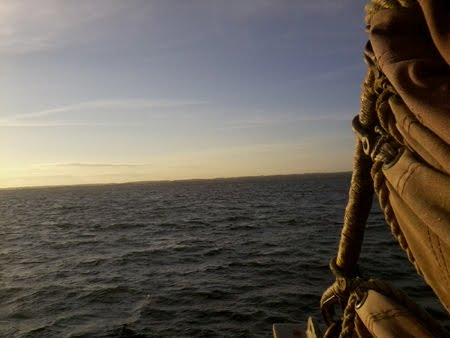
On September 2nd, a crew from Friland went on boat ride from Ebeltoft harbor, to move the sailboat from one location to another. It was beautiful weather and with my hidden enthusiasm for boats there was not a chance I would stay on land. On the boat was the two older men who owns it, three inhabitants of Friland (Morten,Cathrine and little Birk), and three wwoofers (from Switzerland,Australia and Spain). The humor was high, the food alittle unprepared and improvised, and we kept talking about everything from philosophy to real practical ecology, world unity, the value of wwoofing and energy from constructions. Well worth the trip, also for the less shallow conversations. To our happy surprise, we spotted two black dolphins swimming and jumping pretty far from the boat! We couldn't capture them on camera, as they seemed to leave, but through spyglasses we could see them clearly. Dolphins are able to swim along the boats as the social creatures they are, but hopefully we can see them again one time.
Birk and his cool viking-costume

To float is to move sustainably

20100905

Eco in Denmark: Arriving at ecovillage Friland, Djursland


Boat ride on Sept 2nd in a 4 hour sail with other wwoofers and hosts.
About time for some updates. Arriving at "Friland" (Freeland) in Djursland on August 30th and now it is the 5th of September, and many exciting things are going on here already. Right now, I am at the fantasy house of Einer's, who cannot stand squares -so all his equipment and house is formed un-square (soon to be uploaded!), and my previous host until September 4th, was Caroline and Tahir from Pakistan as posted below in the supportlink. 


Arriving at ecovillage Friland, I first started whitewashing the outside wall of my host with calc and water mixed, to cover the brownish straw bales. The house also hosted a kitchen garden, as Friland stribes to become a hundred percent self-sustained as households. Their goals are pretty ambitious, both self-sustained, but also free from all loans. And most of them, has houses and area built for less than 300.000 DKK, which includes material. There is about 100.000 for material, and 200.000 for VVS,watersupply and common area costs. The host I first arrived to is on phase 2 of Friland, which means they are houses in building after phase 1 is almost finished. Phase 3 is in planning, and right now I am just gazing at the open yellow field there. Even though there are plenty more "fantasy buildings" here than at Fri & Fro in Odsherred where I was at first, I'd say I am still waiting for that badass hippie, and most of those who came here are simply average danish families, mostly with first-born children, often from the city and tired of the noices there, and the big wavy skirts and rasta-hairdos are still nowhere to be seen... hmm. Surprising, even here.

My current host's greenhouse, where I am working


20100903

Eco in Denmark: Straw bale houses earth quake resistant

My host in ecovillage "Friland", Caroline Meyer White at Engineers Without Borders in Denmark, is currently working on a specific building project in Pakistan after the flood. She and the engineers are building earth quake friendly straw bale houses with the right technique, to shelter the homeless during the cold winter to arrive! This is for the northern parts of Pakistan, where simple tents won't be enough. And here we also learned something new about straw bale houses: When constructed as explained in the link below, they are tested as earth quake resistant! This way, their new houses will not only shelter them, but also keep them more safe in the years to come, and.. it will be much cheaper to build and easier and faster to build as the locals are brought in who already know much of such building and local material is being used.

NEW INPUT: Straw and compressed straw as one of many natural materials, is different to metal/ bricks and compact material, as straw "breathes" and makes holes and space for the air to flow within its structure, so when the ground shakes the material itself "shakes" in circles with airflow and is more unlikely to collapse than a four-edge, thick wall-structure with no natural "airflow".
From abstract: "The objective of the shake table tests was to assess the seismic response of a 14’ x 14’ x 10’ full-scale house constructed with heavy detailing. The input motion was the Canoga Park Topanga Canyon record of the 1994 Northridge, California earthquake, Mw 6.7. The house was subjected to eight levels of seismic shaking, beginning at 25% of the recorded ground acceleration and increasing at 25% increments. The house survived 0.82g, twice the acceleration of the Canoga Park record. Although severely damaged, the building did not appear in danger of collapse, even at the end of the test sequence."
(Video of shake-table test below, requires Flash):


And at PAKSBAB: http://www.paksbab.org/

Donation-site (danish): SUPPORTPAKISTAN.DK

20100901

Eco in Denmark: Leaving farm in Kyse

Good memories from the apple ecofarm, here are some goodies:

I love the ocean.
More on the "Beatle" in the background further in this post

THE WOOD PELLET STOVE: The heating came from this modern wood pellet stove, a common ecological use in Denmark for saving money and energy. Combined with solar energy for electricity, the stove has some magnificent effects on amounts of hot water. Wood pellets, bought from left-overs at wood firms etc., are heated up to the hot water storage, which delivers domestic hot water and can supply the central heating system at the lowest possible costs.

Me on the tractor for the first time, it was fun


On a bike ride to the beach at Karrebæksminde (a very popular tourist resort), here is a funny "beatle-bridge" for ship traffic and the sign in front of the bridge says: "Save the environment, turn off your engine!" to the cars arriving to cross the bridge. Again: Motivation campaign in the danish spirit!
The "Beatle" :)


Old-fashioned wind mill

20100824

Eco in Denmark: WATER. The household wastewater, acid precipitation and groundwater

Fresh drinking water, acid precipitation, soil water storage, as well as wastewater and groundwater, is a big problem or challenge in today's fresh water loss and biomass growth. Not only is it unhealthy for us, but also with our spill of chemicals, important vegetation is losing minerals to grow and the groundwater itself that is moving outside of the community sewer transportation would end up disturbing already fresh lakes,coastline and rivers that we are also using and animals are in. Big, growing problem... and the EU has decided that all the member countries within year 2015 will have to make sure the water condition is good.

Where to find one solution? On my very first stop on this trip, I cannot avoid telling about their very own constructed waterland system (økologisk pileanlegg)! With inspiration from Odsherred, "Fri og Fro"-ecovillage August 9 - 16:

 
 " We're refreshing our own grey wastewater in a special-designed evaportranspiration construction!" - The folder explains, which I got hold of at the ecovillage in Odsherred, Denmark. As well as our own wastewater, it also takes acid precipitation (sur nedbør) and precipitation as it evaporates (fordamper)!

HERE'S HOW:
A polyethylene-lined basin (the ecovillage in Odsherred has installed 6 basins) filled with soil is planted with clones of willow (Salix viminalis) (piler) grown as a short rotation coppice. The basin receives input from wastewater and precipitation and has no discharge, but the water is evapotranspired by the willow and nutrients are consumed by the willow biomass, which is cut down regularly. 

The species Salix viminalis was effective in evapotranspiring (fordampning). It was concluded that the yearly ETA (måling av fordampning) of the constructed wetlands is more than twice as high as potential evaporation calculated from Makkink. The average potential evaporation (Makkink) in Denmark is 582mmyear-1. The measured ETA from a constructed wetland (økologisk pileanlegg) in Jutland (Jylland) was 1332mmyear -1. (Source:Susanne Rosenild,2005).

The willows, which are fast to grow, are using the minerals in the water to grow and evaporate the water through its leaves. The evaporated water is completely clean,and the report also says the system is called "oasis effect", as it basically is a constructed oasis! Some waterland constructions also plant more vegetation and long rows of willows especially around such a site, to create yet more feedback to the ecosystem. The wastewater is conducted from the single grounds til four bottom tanks, where it gets pushed through some cords up to the waterland construction. Here there are some instruments to analyze the incoming water and water level. 


If there is something wrong in the system, the whole construction actually sends an sms and alarms one of the members of the ecovillage community! Also when there is too much wastewater. What an invention!

For more information, in danish and some english, read an environmental research report here.

From green to blue 2022!

For more green and blue, follow the ongoing Blue Space  collaborative initiative by me , just started up in its beginnings for an enduring l...