Viser innlegg med etiketten eco houses. Vis alle innlegg

20110103

Eco in Norway: Event followup! A Successful Eco Circle.


Group photo of the remaining participating audience at my event, December 18 2010.
A cold winterday the 18th of December 2010 was for some people to celebrate and sacrifice in the name of the obvious Christmas light. Most people went to go shopping in such circumstances, stressed and crowded. Instead, a group of people ready for change chose another alternative of sacrificing and lighting; they chose to enter my ecology event at the end of the autumn roadtrip in Oslo - city of the Tiger and even more; city of the coming greener future with planned urban district Sagene.  The district Sagene was a sponsor of my event.

At the event called "Fornybarfamilien", we came up with alternatives to energy saving, energy consuming, ecology practice, history of danish eco-societies and new economies. A New Year's Resolution is often something we think of as something being persuaded, just like doing the best for your family by buying the greatest stuff for Christmas, while another kind of Resolution could be one to prepare a family meal to the coming generation as in new habits, new environments, new systems of building and restoration, and new matrixes in organizations.

"Fornybarfamilien" (The Renewable Family) showed us that We are the Designers. Here I am trying to use my storytelling for this society's demand of excitement and participation in the age of the cyber nation which is the driving force of today's markets. The advertising industry has used this storytelling strategy for years! Now it is time for us to deliver the same in the sence of green storytelling! The consumers are the end target anyway. And they are driving our cycle in the sentence "what's in it for me". So therefor we are buying what is best told or best performed in the name of what is giving us a quality of life.

Qualities of life have different value in the different ages of time, it was reported. Before, products of high value was a status symbol and a tool to union the like-minded . Today, in our postmodern information society, the value is rather the quality of the products aim to bring us a most sustainable happiness. This way of thinking, is turning our consumer habits upside-down!
Demonstration of how to make your own solar heating from empty cans, by Denmark's engineer specialist on solar power: Ernst Drastrup. The demo was shown at the event.


The main motivation of holding this event, was to stimulate the creative thinking of a greener household and home. Many of the seminar speakers did all of this. The first part of this concept, was a test for upcoming challenges and maybe another event where I would like to bring a greater surrounding and a social experience for the audience to join.

At this event, the participants kept taking notes and asking questions all the time in a very intimate dialogue. The citizen of Samsoe (Samsø / Samso ) Energy Island in Denmark, Stefan Wollfbrandt, told us about all the benefits of his low energy positive house. New economies like ecology and economy in a circular system were also presented in hands-on methods and history of peak oil. We found out that solutions must not consist of only one. Solutions are made to connect , just like any circular system. That is why Denmark, which is a flat country, is a great provider of wind energy, wheras Norway could use alot more fjord or mountain energy.

Each environment has its own solution. We cannot just go blind by the oil prophecies of a greater future because our past was so great and rich, when the resources are running out and as we know it - the peak will come not slow, but fast as long as the rest of the world market expand in a different alternative direction than Norway. We'd have to follow, and we're slow on preparing for its peak. Sweden and Denmark are alot more adaptive.

The vulnerability of not investing in green technologies before it is too late on top of the mountain, was well documented by BI Center of Climate Strategy. The ticking bomb of the green growth was illustrated by a bottle of ketchup being sqeezed like it is now, and suddenly - there will be green all over the place!

At the event, I presented where Denmark is on the map compared to us in Norway. We live in a country with great distance between each other (originally) with mountains separating us, and we are used to an "ownership"-culture where nothing compromises with the mindset of collectiveness. While the danes live flat and connected, they're used to lot more sharing-culture. The challenge for the case of Norway, is that our resources must be rediscovered by ourselves, as it differ from the danish, and we must open up our own eyes to discover our own possibilities.

We usually say that we are lucky to be powered by waterfalls and their engines. And of course it provides us with most of our energy consumption. But even though we can rely on that water power is clean and a good resource for Norway, we also have to ask ourselves whether this is ecologically and holisticly renewable energy or not when it dries our watery ground, cuts off biological diversity, and looks terrible when constructed in our fjords? How renewable is it, then?...

The word holistic, is a part of ecology and the new economy and the new energy politics. The challenge for Norway, is to find our holistic perception again.
Transition Towns Norway was represented at the meeting, as well. They gave us hope on a system of meeting structure that works in plenty other cities and countries, also in a very holistic way of organizing and future-thinking.

The most exciting thing about the "Fornybarfamilien"-event, was that we were able to connect on a grassroot level to exchange views and strategies and telephone numbers for further building, and also coming together for a plot of a "fantasy home!" Everyone was included, and felt included. And as we turned around, we noticed how important it was to get the "inclusion"-factor on, and the "happy-feel-in-an-interactive-moment" on.

A group of people living in a neighbourhood in Oslo asked for more information from Samsoe on how to continue their work, and no outcome is better than that! - The inspiration to a greater action.

Slow Food Oslo also wanted to get more team members to continue their growth in Oslo - ironically for a slower consumption, but faster developement. See , this has turned upside-down! The past organizations of "slow structure/business as usual" has been replaced by fast organization and further own a slow, circular growth.

Seminar programme in Norwegian:
http://fornybarfamilien.origo.no/-/image/show/1620982_program-side1,
http://fornybarfamilien.origo.no/-/image/show/1620983_program-side2

20100923

Eco in Denmark: Not everyone is building.. houses for free! :)

As many have discovered, it takes some time to accomplish a house where you need both effective heating value and the trend is that you're able to sell and not only use energy from your household. Which is why many homes in ecovillages takes time; because you are constantly discovering new green improvements and want to implement it. Still, the house itself, with all its fundament and material, does not necessarily need to book all your everyday meetings. For people on ecovillage Friland who works fulltime and some are in media business rather than farming business and need to get their deadlines to run, there are of course options for these, too! At the moment, I know that the community on phase three is planning some pre-prepared constructions for newcomers who are not so used to building from scratch and might need a helping hand with the ecological fundament, and when the pre-made construction is up they only need to use their imagination and personal sence to fill in the extra space almost like restoring an old apartement which many are used to do in forehand. A very good idea! Maybe not so hard-core knowledge based as you won't get to understand why you're building like this and this, but on the other hand one gets more time to accomplish the rest of the house and garden, and perhaps one can also implement faster the energy-solutions out there. For an even faster solution, one can do like Peter did! :) A friend of mine from Friland who is working alot in daytime with designing and writing books for instance, and of course he would't like this quality of life to compromise with building. There are several options for that, as mentioned with the pre-installations, but he chose something rather quick and for FREE: An old house to be demolited if not carried on WEELS! It costed him no more than 40000DKK to improve, some transport as you can see underneath (but in the long run that is nothing), and the house for free:) Good as new.

House's original position.
Up we go! :)
dum-di-dum here comes your free order, not free transport :)
House's new sunny spot!

20100916

Eco in Denmark: Support concert for Pakistan

Yesterday, the ecovillage Friland arranged a support concert for the flood victims of Pakistan, and the previously mentioned housebuilding-project where my previous host flying to Pakistan this week are already starting to teach new building instructors in the area on how to build with the delivered material. The support concert collected a lot of money, by having volunteers working and musicians playing. I participated making ecological drinks in the bar which we sold, and played a few of my compositions on the piano. The other musicians were a singing duo with folk songs, a violin player, an irish flute player and a drum player. There was singing, dancing and lots of pakistani food made by my prev host and his father. Alittle taste of another world, and we came closer to their reality by seeing how wonderful their food and music culture really is. Seeing the dresses hanging on the wall, made me sence there should be persons wearing them..
selling fabrics and tickets

20100911

I'm making a smaller installation for SupportPakistan

At the moment I got a happy task from Caroline at Engineers Without Borders, which makes me feel I can contribute on a minor scale for a major project. It is to make a small installation in the same dimensions as the bigger houses, to be shown in TV and on stands. And if I had the money, I'd travel down to Pakistan immediately and help them out! They are planning to set up some hundred thousands of this straw bale house below, to shelter people in the cold mountains during the winter. This installation by the way, is making its way to danish tv-stations very soon to be presented, and it is to show the people donating money where their money goes. I think many people like this project, because it is so specific and practical. I am happy that they are getting more publicity to collect more money for this important project of theirs.

20100905

Eco in Denmark: Arriving at ecovillage Friland, Djursland


Boat ride on Sept 2nd in a 4 hour sail with other wwoofers and hosts.
About time for some updates. Arriving at "Friland" (Freeland) in Djursland on August 30th and now it is the 5th of September, and many exciting things are going on here already. Right now, I am at the fantasy house of Einer's, who cannot stand squares -so all his equipment and house is formed un-square (soon to be uploaded!), and my previous host until September 4th, was Caroline and Tahir from Pakistan as posted below in the supportlink. 


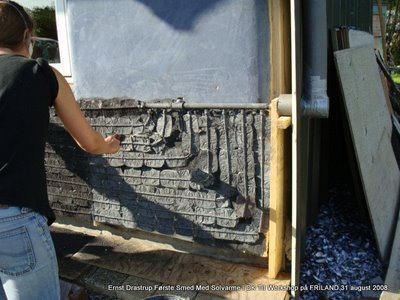
Arriving at ecovillage Friland, I first started whitewashing the outside wall of my host with calc and water mixed, to cover the brownish straw bales. The house also hosted a kitchen garden, as Friland stribes to become a hundred percent self-sustained as households. Their goals are pretty ambitious, both self-sustained, but also free from all loans. And most of them, has houses and area built for less than 300.000 DKK, which includes material. There is about 100.000 for material, and 200.000 for VVS,watersupply and common area costs. The host I first arrived to is on phase 2 of Friland, which means they are houses in building after phase 1 is almost finished. Phase 3 is in planning, and right now I am just gazing at the open yellow field there. Even though there are plenty more "fantasy buildings" here than at Fri & Fro in Odsherred where I was at first, I'd say I am still waiting for that badass hippie, and most of those who came here are simply average danish families, mostly with first-born children, often from the city and tired of the noices there, and the big wavy skirts and rasta-hairdos are still nowhere to be seen... hmm. Surprising, even here.

My current host's greenhouse, where I am working


20100903

Eco in Denmark: Straw bale houses earth quake resistant

My host in ecovillage "Friland", Caroline Meyer White at Engineers Without Borders in Denmark, is currently working on a specific building project in Pakistan after the flood. She and the engineers are building earth quake friendly straw bale houses with the right technique, to shelter the homeless during the cold winter to arrive! This is for the northern parts of Pakistan, where simple tents won't be enough. And here we also learned something new about straw bale houses: When constructed as explained in the link below, they are tested as earth quake resistant! This way, their new houses will not only shelter them, but also keep them more safe in the years to come, and.. it will be much cheaper to build and easier and faster to build as the locals are brought in who already know much of such building and local material is being used.

NEW INPUT: Straw and compressed straw as one of many natural materials, is different to metal/ bricks and compact material, as straw "breathes" and makes holes and space for the air to flow within its structure, so when the ground shakes the material itself "shakes" in circles with airflow and is more unlikely to collapse than a four-edge, thick wall-structure with no natural "airflow".
From abstract: "The objective of the shake table tests was to assess the seismic response of a 14’ x 14’ x 10’ full-scale house constructed with heavy detailing. The input motion was the Canoga Park Topanga Canyon record of the 1994 Northridge, California earthquake, Mw 6.7. The house was subjected to eight levels of seismic shaking, beginning at 25% of the recorded ground acceleration and increasing at 25% increments. The house survived 0.82g, twice the acceleration of the Canoga Park record. Although severely damaged, the building did not appear in danger of collapse, even at the end of the test sequence."
(Video of shake-table test below, requires Flash):


And at PAKSBAB: http://www.paksbab.org/

Donation-site (danish): SUPPORTPAKISTAN.DK

20100806

Eco in Denmark: Odsherred.

Arriving in Odsherred on August 1-9, there was a little village in the middle of the yellow fields. 16 families with children live here, the ecovillage established at a parking lot where the public road ends. In Denmark it is not called "ecovillages", though rather eco society. This is because ecovillages do not only appear in the middle of yellow fields, but also nearby the towns. Because they are so integrated as local contributors, that they are not separated from the average citizen and not seen as anything "exotic". 


Welcoming me at the community, were two parents who were architects from Copenhagen and little girl. Sun was shining, and the garden smiling at my willing hands to take a big deep dig into its soil. Like a village, these houses do have quite big gardens. The biggest investment they probably had to make, was acres of space and field to build their sustainable home. The rest of the upwards - and widely constructed area, costed them the minimum of money.

To understand how cheap it is to build this home and how much they gain from its sustainability, to create yet more freedom and yet more flexible activities in everyday life, one has to know its ground philosophy and ground fundament which I'll try to explain through some of these blog posts. This is not something new in Denmark. In fact, Norway where I come from, is estimated 15 years behind - both in the infrastructure and development of societies like this. 

But the interesing part, is that all industrial countries seem to move towards ecological balance as a result of consumer needs and consumer's deadly health from functional lifestyle, so therefor Denmark and Germany are frontiers of life style whereas countries like Norway do have a lot of peace development across borders and energy research. The sad thing, is that we seem to group ourselves as "they do this" and "we do that" , instead of looking at the society as one building and developing board where we need the eco balance as the pre-fabricated lifestyle seem not so much in balance at all. I'd avoid saying commercial lifestyle, as ecological lifestyle can be super commercial when given a chance, like we have proves in Denmark. So there is no separation between earning and slow consumption here.  

In fact, slow consumption and models given thoughts to profit the society and planet just as much as yourself, seem to be the winning gain in the end. And this we must not forget; our future and now is dependant on each other both ways. So if you want a good now, look at coming aspects so that you can relax. Knowing that your future will be a good one is surprisingly healthy for stress and concentration it seems here at the ecovillage. And the only "stressful" thing you really need to worry about, is to dedicate time for creativity and social meetings to develope the common ground where your house lives. 


Yes, lives. The house lives. And by building breathing straw bale houses, external air conditioning is a no buy and no use. The more natural material, the more they figure out how the elements work with each other to get all the resources we normally just copy from nature in the other synthetic way anyway.  

From green to blue 2022!

For more green and blue, follow the ongoing Blue Space  collaborative initiative by me , just started up in its beginnings for an enduring l...