Viser innlegg med etiketten odsherred. Vis alle innlegg
Viser innlegg med etiketten odsherred. Vis alle innlegg
20100927
Eco in Denmark: Another album
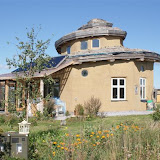
Here is another album from ecovillage "Fri og Fro" in Odsherred, uploaded by Mette Petersen (www.okoliv.dk) living in this ecovillage. Pictures of the homes. Added to the pictures are nice descriptions (in danish) of the building material:
20100905
Eco in Denmark: Arriving at ecovillage Friland, Djursland
 |
| Boat ride on Sept 2nd in a 4 hour sail with other wwoofers and hosts. |
About time for some updates. Arriving at "Friland" (Freeland) in Djursland on August 30th and now it is the 5th of September, and many exciting things are going on here already. Right now, I am at the fantasy house of Einer's, who cannot stand squares -so all his equipment and house is formed un-square (soon to be uploaded!), and my previous host until September 4th, was Caroline and Tahir from Pakistan as posted below in the supportlink.
Arriving at ecovillage Friland, I first started whitewashing the outside wall of my host with calc and water mixed, to cover the brownish straw bales. The house also hosted a kitchen garden, as Friland stribes to become a hundred percent self-sustained as households. Their goals are pretty ambitious, both self-sustained, but also free from all loans. And most of them, has houses and area built for less than 300.000 DKK, which includes material. There is about 100.000 for material, and 200.000 for VVS,watersupply and common area costs. The host I first arrived to is on phase 2 of Friland, which means they are houses in building after phase 1 is almost finished. Phase 3 is in planning, and right now I am just gazing at the open yellow field there. Even though there are plenty more "fantasy buildings" here than at Fri & Fro in Odsherred where I was at first, I'd say I am still waiting for that badass hippie, and most of those who came here are simply average danish families, mostly with first-born children, often from the city and tired of the noices there, and the big wavy skirts and rasta-hairdos are still nowhere to be seen... hmm. Surprising, even here.


 | |||
| My current host's greenhouse, where I am working |
20100824
Eco in Denmark: WATER. The household wastewater, acid precipitation and groundwater
Fresh drinking water, acid precipitation, soil water storage, as well as wastewater and groundwater, is a big problem or challenge in today's fresh water loss and biomass growth. Not only is it unhealthy for us, but also with our spill of chemicals, important vegetation is losing minerals to grow and the groundwater itself that is moving outside of the community sewer transportation would end up disturbing already fresh lakes,coastline and rivers that we are also using and animals are in. Big, growing problem... and the EU has decided that all the member countries within year 2015 will have to make sure the water condition is good.
Where to find one solution? On my very first stop on this trip, I cannot avoid telling about their very own constructed waterland system (økologisk pileanlegg)! With inspiration from Odsherred, "Fri og Fro"-ecovillage August 9 - 16:
Where to find one solution? On my very first stop on this trip, I cannot avoid telling about their very own constructed waterland system (økologisk pileanlegg)! With inspiration from Odsherred, "Fri og Fro"-ecovillage August 9 - 16:

" We're refreshing our own grey wastewater in a special-designed evaportranspiration construction!" - The folder explains, which I got hold of at the ecovillage in Odsherred, Denmark. As well as our own wastewater, it also takes acid precipitation (sur nedbør) and precipitation as it evaporates (fordamper)!
HERE'S HOW:
A polyethylene-lined basin (the ecovillage in Odsherred has installed 6 basins) filled with soil is planted with clones of willow (Salix viminalis) (piler) grown as a short rotation coppice. The basin receives input from wastewater and precipitation and has no discharge, but the water is evapotranspired by the willow and nutrients are consumed by the willow biomass, which is cut down regularly. The species Salix viminalis was effective in evapotranspiring (fordampning). It was concluded that the yearly ETA (måling av fordampning) of the constructed wetlands is more than twice as high as potential evaporation calculated from Makkink. The average potential evaporation (Makkink) in Denmark is 582mmyear-1. The measured ETA from a constructed wetland (økologisk pileanlegg) in Jutland (Jylland) was 1332mmyear -1. (Source:Susanne Rosenild,2005).
The willows, which are fast to grow, are using the minerals in the water to grow and evaporate the water through its leaves. The evaporated water is completely clean,and the report also says the system is called "oasis effect", as it basically is a constructed oasis! Some waterland constructions also plant more vegetation and long rows of willows especially around such a site, to create yet more feedback to the ecosystem. The wastewater is conducted from the single grounds til four bottom tanks, where it gets pushed through some cords up to the waterland construction. Here there are some instruments to analyze the incoming water and water level.
If there is something wrong in the system, the whole construction actually sends an sms and alarms one of the members of the ecovillage community! Also when there is too much wastewater. What an invention!
For more information, in danish and some english, read an environmental research report here.
20100806
Eco in Denmark: Odsherred.
Arriving in Odsherred on August 1-9, there was a little village in the middle of the yellow fields. 16 families with children live here, the ecovillage established at a parking lot where the public road ends. In Denmark it is not called "ecovillages", though rather eco society. This is because ecovillages do not only appear in the middle of yellow fields, but also nearby the towns. Because they are so integrated as local contributors, that they are not separated from the average citizen and not seen as anything "exotic".

Welcoming me at the community, were two parents who were architects from Copenhagen and little girl. Sun was shining, and the garden smiling at my willing hands to take a big deep dig into its soil. Like a village, these houses do have quite big gardens. The biggest investment they probably had to make, was acres of space and field to build their sustainable home. The rest of the upwards - and widely constructed area, costed them the minimum of money.
To understand how cheap it is to build this home and how much they gain from its sustainability, to create yet more freedom and yet more flexible activities in everyday life, one has to know its ground philosophy and ground fundament which I'll try to explain through some of these blog posts. This is not something new in Denmark. In fact, Norway where I come from, is estimated 15 years behind - both in the infrastructure and development of societies like this.
But the interesing part, is that all industrial countries seem to move towards ecological balance as a result of consumer needs and consumer's deadly health from functional lifestyle, so therefor Denmark and Germany are frontiers of life style whereas countries like Norway do have a lot of peace development across borders and energy research. The sad thing, is that we seem to group ourselves as "they do this" and "we do that" , instead of looking at the society as one building and developing board where we need the eco balance as the pre-fabricated lifestyle seem not so much in balance at all. I'd avoid saying commercial lifestyle, as ecological lifestyle can be super commercial when given a chance, like we have proves in Denmark. So there is no separation between earning and slow consumption here.

In fact, slow consumption and models given thoughts to profit the society and planet just as much as yourself, seem to be the winning gain in the end. And this we must not forget; our future and now is dependant on each other both ways. So if you want a good now, look at coming aspects so that you can relax. Knowing that your future will be a good one is surprisingly healthy for stress and concentration it seems here at the ecovillage. And the only "stressful" thing you really need to worry about, is to dedicate time for creativity and social meetings to develope the common ground where your house lives.

Yes, lives. The house lives. And by building breathing straw bale houses, external air conditioning is a no buy and no use. The more natural material, the more they figure out how the elements work with each other to get all the resources we normally just copy from nature in the other synthetic way anyway.

Welcoming me at the community, were two parents who were architects from Copenhagen and little girl. Sun was shining, and the garden smiling at my willing hands to take a big deep dig into its soil. Like a village, these houses do have quite big gardens. The biggest investment they probably had to make, was acres of space and field to build their sustainable home. The rest of the upwards - and widely constructed area, costed them the minimum of money.
To understand how cheap it is to build this home and how much they gain from its sustainability, to create yet more freedom and yet more flexible activities in everyday life, one has to know its ground philosophy and ground fundament which I'll try to explain through some of these blog posts. This is not something new in Denmark. In fact, Norway where I come from, is estimated 15 years behind - both in the infrastructure and development of societies like this.
But the interesing part, is that all industrial countries seem to move towards ecological balance as a result of consumer needs and consumer's deadly health from functional lifestyle, so therefor Denmark and Germany are frontiers of life style whereas countries like Norway do have a lot of peace development across borders and energy research. The sad thing, is that we seem to group ourselves as "they do this" and "we do that" , instead of looking at the society as one building and developing board where we need the eco balance as the pre-fabricated lifestyle seem not so much in balance at all. I'd avoid saying commercial lifestyle, as ecological lifestyle can be super commercial when given a chance, like we have proves in Denmark. So there is no separation between earning and slow consumption here.

In fact, slow consumption and models given thoughts to profit the society and planet just as much as yourself, seem to be the winning gain in the end. And this we must not forget; our future and now is dependant on each other both ways. So if you want a good now, look at coming aspects so that you can relax. Knowing that your future will be a good one is surprisingly healthy for stress and concentration it seems here at the ecovillage. And the only "stressful" thing you really need to worry about, is to dedicate time for creativity and social meetings to develope the common ground where your house lives.

Yes, lives. The house lives. And by building breathing straw bale houses, external air conditioning is a no buy and no use. The more natural material, the more they figure out how the elements work with each other to get all the resources we normally just copy from nature in the other synthetic way anyway.
Abonner på:
Innlegg (Atom)
From green to blue 2022!
For more green and blue, follow the ongoing Blue Space collaborative initiative by me , just started up in its beginnings for an enduring l...
.png)
-
 .. and more from the stay in Friland: Photo album and building workshop. To be uploaded soon!
 -
 Natural "disasters" are here to stay. They`ve forever been here, but as the world is more connected than ever, all incidents hit...
 -
 In Norway, we have loads of ecological innovation in both technology, architecture, recycling and education. But I´d say the position where ...