Viser innlegg med etiketten family. Vis alle innlegg

20110217

Eco in Sweden: We're all Global Natives. The importance of keep travelling.

Gothenburg Museum of World Culture
I went to see an exciting exhibition at the World Culture Museum in our nabour country Sweden, which gave me some thoughts on the importance of travelling, and the reason why travelling does make you more aware of the environment if you're one of the globalized modern people. And also, that humans originally are migratory species and the idea of "Nations" is a relatively new idea historically speaking when we think thousands and not hundereds of years back- who would guess that! Evolution has it that prolonged settlement has a vertical axis of some ten thousand years, as explained on this badge:


Isolation, as we know it, is not very ecological. Permanent permaculture, maybe, if constructed in an international eco society. But most of us, do not live within permaculture or tend to think of the environment in every aspect, and therefor we have lost a lot of the experience since no grandfather is teaching us such anymore. Becoming more aware is not just for the political activists anymore, either. Some, even without activism in blood, might become even more active in the ecological field after travelling just a few places around the globe for getting the sense of another environment and culture, and we experience not only change in the culture shock, but also change within ourselves.

We will realize, that your homestead is largely influenced by your local supermarket instead of the wide inspiration on earth. My travel, has for sure expanded my horizons to become more aware. Even though it's not "to become aware", it became a result of the whole travel. The travel itself, was to get what I've felt is missing. And what is missing, lies within all of us. From this exhibition, images and words were explaining my travel sum-up.

Our late ancestors were local people with global economy ambitions; travel to conquer - not to explore, and to bring home the goods of another world, leaving traces in a rather brutal way.

But, our early ancestors on the other hand,  were more likely global people with no permanent homes, living with local economies.

We wandered all the way from early Stone Age to the previous ice ages, coping with environments we'd never dream of coping with today, sleeping with the Neanderthals, giving in to the mushroom feed and continuing with travel across Asia and the northern territory, continuing using our native drums in music all the way from Africa and bringing tents on animals who became our carriers, like donkeys and horses. Why did we travel or, did we?

When we are on travel, we are also at home. We are where we are. Present. I`d like to state that we need to remember that the continents in very early ages of humankind, looked quite different from today.. the Mediterranean was not there, and Africa was linked to Asia, South America to Europe (a new discovery of link between Palestine and Native Americans) and Australia to The Middle East and Egypt- making the tribes of Aborigine and Sumerian quite familiar at some points, that we can also spot in their spiritual habits of "free the soul"-rituals.

Further more, the islands of Fiji, Haiti, Easter Island and even Hawaii did not exist in the shape they are today, they were linked to the mainland, and which - made all native tribes more "in contact" with each other, and wandering between places for finding new "green areas" for their animals to feed them. In fact, there is a link through all natives in all countries in the semi-nomadic lifestyle. Why do they otherwise look so the same, to us? Why do we still call natives - "natives"? the cultures have changed, alongside nations, but we still know they like to keep some of their past traditions.

They all live from day- to- day-basis ,like using sun dials instead of daily clocks controlling time schedule. When building community for the future and now, their significance is especially to maintain a vertical family- and society structure. This is an opposite to our horizontal structure for forward-thinking.

Having vertical structure, means that their rituals or traditions (like cooking or music; in other words identity ) are based on ancient pride, while usage of resources and leadership-communities are based on future generations' and climate demands, often formed as spiral seashells in dialogue. Even their dance routines generally speaking, is often a spiral form dance. Based on ancestor-instincts, but also based on the fact that the whole Earth had ONE source (the very elements we all need to live), and not divided into several states and several powers.
Wheather-harmony; Sun Dials in most native societies.

When we started conquering other countries (mainly the British...erm), and separeted ourselves from nature, we also unfortunately made all our natives separate into many "different" tribes and conditions. WE as high-industrial nations, actually made them isolated. They were not, from the beginning, isolated from the rest of the world, even how local and soul-searching they might seem. So, this whole concept of ideas we have of isolated, primitive and not-so-global natives are completely wrong ideas. They were in fact our global citizens, that we are stribing to become today in all our adjustment to globalization and universal ideas, long before we started to name anyone a president or anyone a king.

The importance of travelling (in the aim of discovery) is therefor something we must not reconsider together with all the other things we are reconsidering today that are environmentally friendly. Yes, I am aware of plane traffics, but on the other hand - without transport of people in and out of other countries, how can we then become ecologically educated enough to provide politics or even make decisions that are affecting other countries? We NEED to get to know our roots and ourselves better by asking our neighbor, to understand that we are connected.

Not to mention, to appreciate the beauty of nature's diversity. When travelling, you are "forced" to look around. You can not escape from finding challenges in nature on your road, and you can not escape from meeting new people that are local experts on their own natural fields. I am all - into travel. And, I will continue with it. On the other note: Travelling has made me more aware of the many local economies out there. That the global economy we once were dependant on, is shrinking. This is extremely important. Learning is by experiencing differences and similarities, also.


Because life would never be able to evolve, without a knowledge and practice of a local feed, then on a global scale we need information of local climate to survive. And when you understand what is local, you might also start to build bridges between your own habitat - and - theirs, more like a winwin-union; where local opportunities meet global challenges and generational teaching can continue. This is when the Earth will evolve, I believe. When we understand that there are more roads than what is decided by your government or by your ruling company, when we see more than just 1 road which would more like to take personal advantages of your local resource than to develop it, honestly. To get into the depth of the soil we all came from, I guess the first step is to start exploring it, digging it, and if you can't access Google Mongolia or Google Amazon to breath the clean oxygen from trees and climbing mountains, you'd need to go and look for it yourself! Reading about it is one thing, experience is something quite different.

Apart from our civilized, organized and growing families within nations, we're all global natives from the very roots.


20110103

Eco in Norway: Event followup! A Successful Eco Circle.


Group photo of the remaining participating audience at my event, December 18 2010.
A cold winterday the 18th of December 2010 was for some people to celebrate and sacrifice in the name of the obvious Christmas light. Most people went to go shopping in such circumstances, stressed and crowded. Instead, a group of people ready for change chose another alternative of sacrificing and lighting; they chose to enter my ecology event at the end of the autumn roadtrip in Oslo - city of the Tiger and even more; city of the coming greener future with planned urban district Sagene.  The district Sagene was a sponsor of my event.

At the event called "Fornybarfamilien", we came up with alternatives to energy saving, energy consuming, ecology practice, history of danish eco-societies and new economies. A New Year's Resolution is often something we think of as something being persuaded, just like doing the best for your family by buying the greatest stuff for Christmas, while another kind of Resolution could be one to prepare a family meal to the coming generation as in new habits, new environments, new systems of building and restoration, and new matrixes in organizations.

"Fornybarfamilien" (The Renewable Family) showed us that We are the Designers. Here I am trying to use my storytelling for this society's demand of excitement and participation in the age of the cyber nation which is the driving force of today's markets. The advertising industry has used this storytelling strategy for years! Now it is time for us to deliver the same in the sence of green storytelling! The consumers are the end target anyway. And they are driving our cycle in the sentence "what's in it for me". So therefor we are buying what is best told or best performed in the name of what is giving us a quality of life.

Qualities of life have different value in the different ages of time, it was reported. Before, products of high value was a status symbol and a tool to union the like-minded . Today, in our postmodern information society, the value is rather the quality of the products aim to bring us a most sustainable happiness. This way of thinking, is turning our consumer habits upside-down!
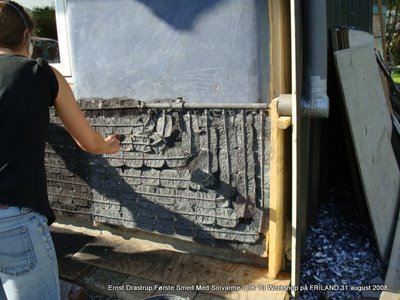
Demonstration of how to make your own solar heating from empty cans, by Denmark's engineer specialist on solar power: Ernst Drastrup. The demo was shown at the event.


The main motivation of holding this event, was to stimulate the creative thinking of a greener household and home. Many of the seminar speakers did all of this. The first part of this concept, was a test for upcoming challenges and maybe another event where I would like to bring a greater surrounding and a social experience for the audience to join.

At this event, the participants kept taking notes and asking questions all the time in a very intimate dialogue. The citizen of Samsoe (Samsø / Samso ) Energy Island in Denmark, Stefan Wollfbrandt, told us about all the benefits of his low energy positive house. New economies like ecology and economy in a circular system were also presented in hands-on methods and history of peak oil. We found out that solutions must not consist of only one. Solutions are made to connect , just like any circular system. That is why Denmark, which is a flat country, is a great provider of wind energy, wheras Norway could use alot more fjord or mountain energy.

Each environment has its own solution. We cannot just go blind by the oil prophecies of a greater future because our past was so great and rich, when the resources are running out and as we know it - the peak will come not slow, but fast as long as the rest of the world market expand in a different alternative direction than Norway. We'd have to follow, and we're slow on preparing for its peak. Sweden and Denmark are alot more adaptive.

The vulnerability of not investing in green technologies before it is too late on top of the mountain, was well documented by BI Center of Climate Strategy. The ticking bomb of the green growth was illustrated by a bottle of ketchup being sqeezed like it is now, and suddenly - there will be green all over the place!

At the event, I presented where Denmark is on the map compared to us in Norway. We live in a country with great distance between each other (originally) with mountains separating us, and we are used to an "ownership"-culture where nothing compromises with the mindset of collectiveness. While the danes live flat and connected, they're used to lot more sharing-culture. The challenge for the case of Norway, is that our resources must be rediscovered by ourselves, as it differ from the danish, and we must open up our own eyes to discover our own possibilities.

We usually say that we are lucky to be powered by waterfalls and their engines. And of course it provides us with most of our energy consumption. But even though we can rely on that water power is clean and a good resource for Norway, we also have to ask ourselves whether this is ecologically and holisticly renewable energy or not when it dries our watery ground, cuts off biological diversity, and looks terrible when constructed in our fjords? How renewable is it, then?...

The word holistic, is a part of ecology and the new economy and the new energy politics. The challenge for Norway, is to find our holistic perception again.
Transition Towns Norway was represented at the meeting, as well. They gave us hope on a system of meeting structure that works in plenty other cities and countries, also in a very holistic way of organizing and future-thinking.

The most exciting thing about the "Fornybarfamilien"-event, was that we were able to connect on a grassroot level to exchange views and strategies and telephone numbers for further building, and also coming together for a plot of a "fantasy home!" Everyone was included, and felt included. And as we turned around, we noticed how important it was to get the "inclusion"-factor on, and the "happy-feel-in-an-interactive-moment" on.

A group of people living in a neighbourhood in Oslo asked for more information from Samsoe on how to continue their work, and no outcome is better than that! - The inspiration to a greater action.

Slow Food Oslo also wanted to get more team members to continue their growth in Oslo - ironically for a slower consumption, but faster developement. See , this has turned upside-down! The past organizations of "slow structure/business as usual" has been replaced by fast organization and further own a slow, circular growth.

Seminar programme in Norwegian:
http://fornybarfamilien.origo.no/-/image/show/1620982_program-side1,
http://fornybarfamilien.origo.no/-/image/show/1620983_program-side2

20100905

Eco in Denmark: Arriving at ecovillage Friland, Djursland


Boat ride on Sept 2nd in a 4 hour sail with other wwoofers and hosts.
About time for some updates. Arriving at "Friland" (Freeland) in Djursland on August 30th and now it is the 5th of September, and many exciting things are going on here already. Right now, I am at the fantasy house of Einer's, who cannot stand squares -so all his equipment and house is formed un-square (soon to be uploaded!), and my previous host until September 4th, was Caroline and Tahir from Pakistan as posted below in the supportlink. 


Arriving at ecovillage Friland, I first started whitewashing the outside wall of my host with calc and water mixed, to cover the brownish straw bales. The house also hosted a kitchen garden, as Friland stribes to become a hundred percent self-sustained as households. Their goals are pretty ambitious, both self-sustained, but also free from all loans. And most of them, has houses and area built for less than 300.000 DKK, which includes material. There is about 100.000 for material, and 200.000 for VVS,watersupply and common area costs. The host I first arrived to is on phase 2 of Friland, which means they are houses in building after phase 1 is almost finished. Phase 3 is in planning, and right now I am just gazing at the open yellow field there. Even though there are plenty more "fantasy buildings" here than at Fri & Fro in Odsherred where I was at first, I'd say I am still waiting for that badass hippie, and most of those who came here are simply average danish families, mostly with first-born children, often from the city and tired of the noices there, and the big wavy skirts and rasta-hairdos are still nowhere to be seen... hmm. Surprising, even here.

My current host's greenhouse, where I am working


From green to blue 2022!

For more green and blue, follow the ongoing Blue Space  collaborative initiative by me , just started up in its beginnings for an enduring l...